Arkham Horror: The Card Game
Arkham Horror: The Card Game is the sort of game that comes with a series of disclaimers. Here are mine:
The theme is Lovecraftian horror. While the bits of text avoid any hint of the early twentieth century views on race that Lovecraft might have shared with his contemporaries, it still hews to the mythos of his writings. I tend to agree with Borges that Lovecraft was “an involuntary parodist of Poe”. To deal with this, I imagine the Arkham Horror events to be prequels to the cases of The X-Files. (Your mileage may vary.)
Purchasing the core box might be compared to acquiring Pandora’s box if you tend to completionism. As it approaches a decade of continuously released and re-released content, the game can get quite expensive. There are 11 cycles plus numerous standalone scenarios, starter decks and even “Return to” boxes that redo early cycles. At the time of this writing, I have an entire unopened cycle and starter deck so I ought to avoid buying more content. Unfortunately, I’m constantly looking on eBay for more Arkham Horror stuff and will probably acquire more.
Arkham Horror has used two conflicting distribution models. For the core set there are three possible ways to get started. The original core set supports one or two players, so you need to get a second core to play with three or four. Even as a solo-only player, I got a second core because it helps to have a second copy of the various investigator cards to build stronger decks. One core suffices to get the feel of the game, though.
The difficulty with getting two cores is that you also get two copies of the scenario cards, which is wasteful. So the publisher shifted to a “revised” core that included a full compliment of investigator cards and a cloth bag, which was surprisingly missing from the original box. It also swaps out a few cards that could matter for some investigators and includes better tokens. Unless you find the original core for a cut-rate price, you’ll probably want to stick with the revised core.
The situation with expansions is, if anything, more complicated. See near the end of this review for details. And to top things off, Fantasy Flight recently announced a new core set. If you are entirely new to the game, it seems best to hold off until the second chapter is released and avoid the confusing release models that currently exist.
On to the review
Arkham Horror: The Card Game isn’t really a game, but rather a game system. The core box (revised or original recipe) is designed to show you enough of the system to encourage you to buy expansions. The clearest sign comes when opening the rule book that lists key words alphabetically and has four appendices. Some of what you read there only matters when playing with expansions, but there it is in your core box.
Luckily there’s another book called Learn to Play that guides players through the first scenario, which is more or less a tutorial. “Tutorial” might sound dismissive and yet “The Gathering” is both an excellent introduction to the game system and an enjoyable scenario to replay with different investigators as the protagonists of the story. It starts in a single room with no way out.
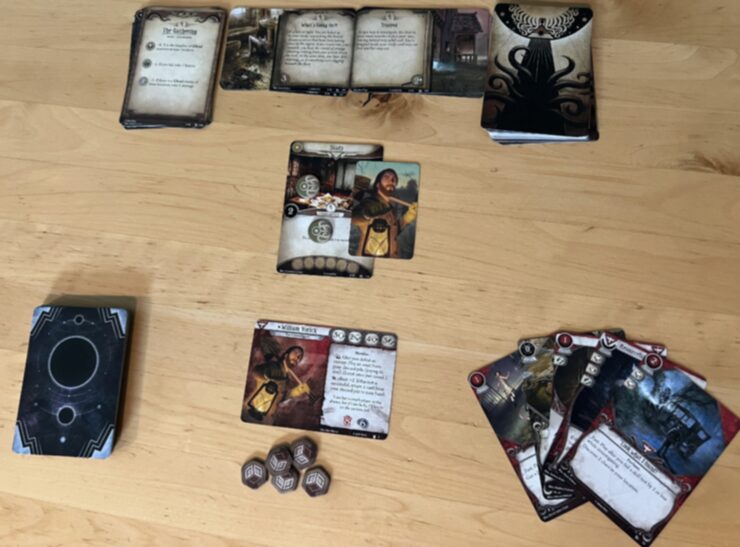
With the exception of cardboard tokens for tracking purposes or to be pulled from the “chaos” bag to generate randomness, everything in Arkham Horror: The Card Game is a card. Locations are also cards with a revealed and unrevealed side depending on whether an investigator has visited the location. As implied by the name, investigators will need to search the locations for clues using their own custom deck of cards representing various assets, skills and events.1
Two decks of cards represent the recto and verso of a book. The “Act” deck usually represents progress the investigators have made uncovering the scenario’s mystery. (Note: even when I don’t say it, you can sprinkle “most of the time”, “generally”, “almost always”, etc. in this review. There’s a good chance some card will break the usual pattern in some expansion or another.) Meanwhile, doom tokens must be added to the “agenda” deck each turn (after the first) to mark time until, as implied by the word “doom”, something bad happens to the investigators. At the start of each turn (after the first), to further hamper investigators, each draws an enemy or a treachery from the “encounter” deck.
All exits from the first location in the first scenario are locked when play starts. Fortunately there are “clues” spread around the room. If your investigators collect enough, they can flip the top card of the “act” deck. That’s usually a good thing and in this case it reveals a way out. Yes, this is an escape room for your investigators. One way they can find clues in the room is to take an “investigate” action, which compares the investigator’s “intelligence” to the location’s “shroud”. If intelligence is greater than or equal to shroud, the investigation succeeds and a clue is found. Unfortunately, you must grab a token out of the “chaos bag” which will modify the intelligence stat. Even on Easy difficulty, that’s more likely to lower intelligence than raise it.
It’s a classic cooperative game setup: achieve your objectives before the timer runs out. The scenario continues after completing the objective on the first act card or after the agenda advances. At some point your investigators will arrive at a resolution. Even after a party-wipe situation there’s usually a way to move onto the next scenario in a campaign, though with fewer experience points to spend on upgrading your deck and likely other negative consequences for future scenarios.
The second scenario in the core box, Midnight Masks, is considered a classic. Depending on how well (or poorly) your investigators have performed in the first scenario, you’ll have experience points to spend on improving their decks. Experience opens up new cards or upgraded versions of “level 0” cards. You can expect incremental changes since the points can’t usually buy more than a couple of replacements in 30-card deck. Still, it’s a great feeling to pull a card you just picked up and watch it solve a difficult problem.
It was while playing this scenario for the first time that I caught onto the flow of Arkham Horror. Each investigator may spend 3 actions a turn. There are a standard set of actions (investigating, fighting, moving, etc.) that can be used anytime. Some cards, including locations and story cards, offer other actions or improved version of the standard actions. As with all good action-point games, there are never enough actions to do what you want in a turn. So the puzzle is finding the best combination of actions to make progress in the act deck without risking catastrophe when drawing encounters.
The finale, The Devourer Below, has a reputation of being unfair and unfun. Scenarios in Arkham Horror must serve two purposes:
- The first time someone plays a scenario (the blind play-through), it tells a story of mystery and the uncanny.
- Subsequent plays begin to lose the story element and become puzzles to be solved.
The first two scenarios work well as stories even after playing a few times and continue to be interesting puzzles for testing new investigator decks. Choices you make in those scenarios impact the final scenario in the campaign, which is a great idea, but not well implemented here. Other campaigns do it better, but they also have the luxury of 8 or more scenarios to build up to a final confrontation. With three scenarios (one of which is a tutorial), the core box ramps up the difficulty curve in short order.2 Arkham Horror presumes players will lose the campaign the first time through and even the “good” ending comes with shadows of regret.
The Devourer Below doesn’t hold up to repeat plays. It’s like a video game boss where players have discovered a place to hide while healing. In this case, it can make sense to not advance the act deck. Despite random locations and a random element in the encounter deck, the scenario somehow lacks interesting discoveries. Or maybe the excess randomness blocks player from injecting meaning into events that will be interrupted by the arrival of a massive final boss.
If you play with the decks suggested in the Learn to Play book, you’ll find it hard to work out a reliable strategy. The cards just aren’t focused, which isn’t how decks succeed. Getting a second core set or the revised core at least grants you the opportunity to pack two copies of investigator cards. Even so, it’s easy to water down a deck with cards that don’t work very well together. A good way to learn how to build better decks is to seek out the Structure Deck Series on ArkhamDB. In addition to better decks, the deck notes explain the theory behind them.
The core investigators give a taste of the five classes of investigators. Seekers tend to be good at investigating, Guardians have the tools to fight off enemies, Rogues deal in resource acquisition and conversion, Mystics dabble in weird powers, and Survivors seem to succeed even when failing. Even with just one example of each class, the core set shows off the inventiveness of the full roster of Arkham Horror investigators.
Many investigator cards in the core set hold up in later expansions. Some cards are staples even with a much larger collection and others get better when they combo off of later additions to your collection. It’s a well-thought-out set to start with. Still, this is a game designed to sell more content and adding other sets will improve your experience. So let’s talk expansions.
Getting expansions
If the core set sparks an interest in playing more, I highly recommend taking a look at A FOMO-free Buying Guide, which walks through all the things you can (but don’t need to) buy from the perspective of someone has invested in everything. I’ll just add a little advice as a relative newcomer.
I mentioned getting the expansions was complicated by a change in distribution model. Originally new content was released each month. Everyone would start a new cycle with a “Deluxe” expansion that included 5 new investigators, a handful of investigator cards and 2 opening scenarios. Next month a new “Mythos Pack” would come out with a few more investigator cards and another scenario. Each new scenario would build on the campaign and after 6 Mythos Packs, the cycle would be completed. Then a new cycle could start.
One problem with this model was that some people wanted the new investigator cards and didn’t care about the campaign. Or the other way around. While investigators do tend to have thematic connections to the campaign they are tied to, they aren’t out-of-place in other campaigns. Another problem is that if you miss one the Mythos Packs, it’s harder to complete the cycle.
So starting with Edge of the Earth, the cycle was sold in two boxes:
- An Investigator Expansion that includes the new investigators and cards.
- A Campaign Expansion that includes all the scenarios.
This made the expansion easier to purchase and the model has been back-ported to the older cycles. Unfortunately the older cycles are going out of print, so your options are:
- Skip the old campaigns and buy new Investigator and Campaign expansions that are in print.
- Find used copies of older cycles in the new packaging.
- Piece together a complete cycle by finding the “Deluxe” expansion and all 6 mythos packs.
I’ve had good luck with the last since there are copies in the wild purchased by people who have either stopped playing the game or who bought more expansions than they ended up playing. This can spread out the cost and drip-feed content. Certain mythos packs command high prices, however.
That said, it’s likely easier to just buy the new format. If you do, you can get a new campaign and add investigators from another cycle. Be aware, however, that some sellers either don’t know which version they are selling or deceptively fail to note they are selling the old format and not the new. The guide I mentioned before really does help make the decision of which campaign to start with. From there, it depends on how much the system draws you in and how much you want to invest in it.
Bottom line
As an sample of the what the game offers, the core set (whether the revised or original) does the job. I played it 3 or 4 times to try out the different investigators. It’s not terribly expensive (especially the original core) and if you don’t feel inspired by the system, there’s no reason to invest more.
But for those who do want to continue, the core set (either the revised or two original cores) anchor your collection. Should you dig deeper into Arkham Horror, you will likely find yourself spending at least as much time constructing a perfect deck (likely on ArkhamDB) as you will playing the actual game.
Yes, you can cause events to happen at will.↩︎
There is also a crucial card that’s easy to misunderstand which dramatically reduces the time allowed to complete the final act if you don’t read it carefully.↩︎