Friday is a masterpiece of theme, deckbuilding and push-your-luck
Originally published on Board Game Geek.
Robinson Crusoe’s ship has floundered off the coast of a desolate island, he is the only survivor and he has nothing but his innate skills and behaviors at his disposal. The good news is he is a genius (+2) and can be focused (+1) from time to time. The bad news is he’s weak (0) and easily distracted (-1). In the game, these attributes manifest via a starting deck of 18 cards.
You are not playing as Robinson Crusoe, though. You are Friday. But not the Friday that Daniel Defoe wrote about. Not exactly. There’s a moment in the novel that stands out to the reader:
It happened one day about noon, going towards my boat, I was exceedingly surprised with the print of a man’s naked foot on the shore, which was very plain to be seen in the sand: I stood like one thunder-struck, or as if I had seen an apparition.
Years later Robinson rescues Friday from cannibals, so that’s probably not his footprint. But what if it was? Friday, the game, supposes that Friday, the man, secretly guides Robinson along his journey of survival and learning. It starts with the choice of what to do each day. Is Robinson ready to fight wild animals or should he stick closer to his camp?
This choice is made by picking one of two cards pulled from another deck that contains hazards of various levels. The easiest (labeled slightly nonsensically “with the raft to the wreck”) allows Robinson to play a single card in order to overcome the challenge of recovering something from the shipwreck. Initially even a weak Robinson can accomplish the task since it only requires 0 fight. But when you go through the hazard deck the second time the challenge is increased to 1 and the third time to 3. You can picture the surf breaking up the wreck and carrying items into the depths. The other hazards are “exploring the island”, “further exploring the island”, “wild animals”, and, of course, “cannibals”. Each level has increasingly difficult fight thresholds while allowing Robinson to freely play more cards in order to defeat the hazard.
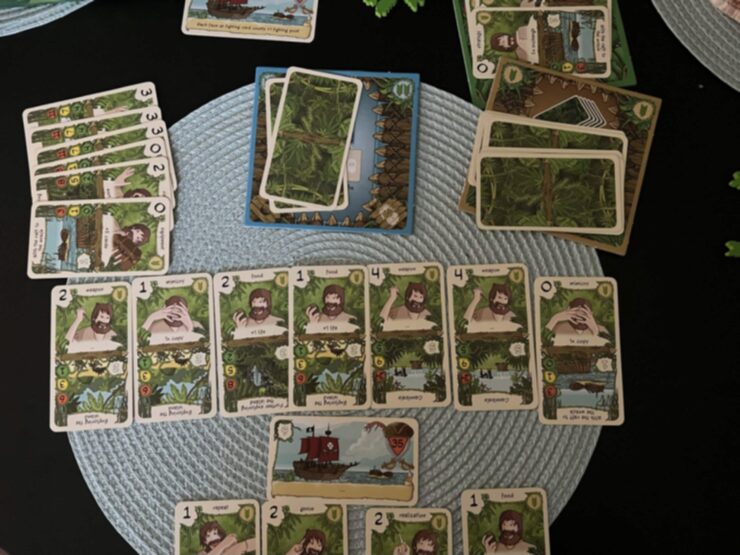
Beating the hazard allows you to take the hazard card and turn it 180° making it a card for Robinson to add to his discard pile. Successfully fighting the cannibals might reward him with a weapon that adds 4 to his fighting strength. Scavenging the wreckage could allow Robinson to return with equipment, books or food. Or he might gain a trait such as deception, vision or experience. In addition to a fight number, many of the added cards grant him special powers such as drawing free cards or exchanging cards in play with new cards from the deck.
Now losing against a hazard isn’t all bad news. You won’t get the extra card for your Robinson deck and you will lose life points according to had badly you botched the job. But you also can cull cards according to the number of life points you lost. Turning up a distracted card when you set out on a raft turns out to be a decent outcome because you can guarantee it won’t ruin your day in the future at a relatively small price. Some cards include a special ability to destroy a card in play, so failing isn’t the only way to remove cards. But especially at the beginning failure is always an option and a good way of eliminating some of Robinson’s bad habits.
Friday’s goal is to get Robinson in tip-top shape for the final showdown against two ships of pirates. Working against that goal are aging cards, which are added each time you exhaust the Robinson deck. They start off bad and end worse. If you run out of aging cards, Robinson dies of old age. You must also track Robinson’s health via life point tokens. Run out of those and he’s overcome by injuries and illness. Changes to the aging deck and initial life points allow players to adjust the difficulty. That won’t be necessary for a few plays though.
Friday’s designer, Friedemann Friese, expertly balanced the hazards so that Robinson rarely defeats them with the number of free cards they specify. If you want to get the reward, you must spend a life point token to play another card. If you are lucky, you’ll beat the hazard and take the win. Alternatively, you might pull a card that makes it more efficient to lose and cull some junk from the deck. But frequently you’ll be put in the position of losing without a good option and must once again decide whether to risk another life point to turn another card. Especially during the third time through the hazard deck, you risk falling into a trap where you can’t win unless you spend a life point.
It’s a game where decisions start easy and progressively get trickier. Good decisions hinge on knowing the state of the Robinson deck. Since you’ve mostly built the deck yourself, that doesn’t seem too hard. But a stray aging card or a choice between equally daunting hazards can put Robinson into a spiral he can’t recover from. Friday never feels unfair, but it’s quick to punish a bad decision. That makes winning all the sweeter.