USS Lox
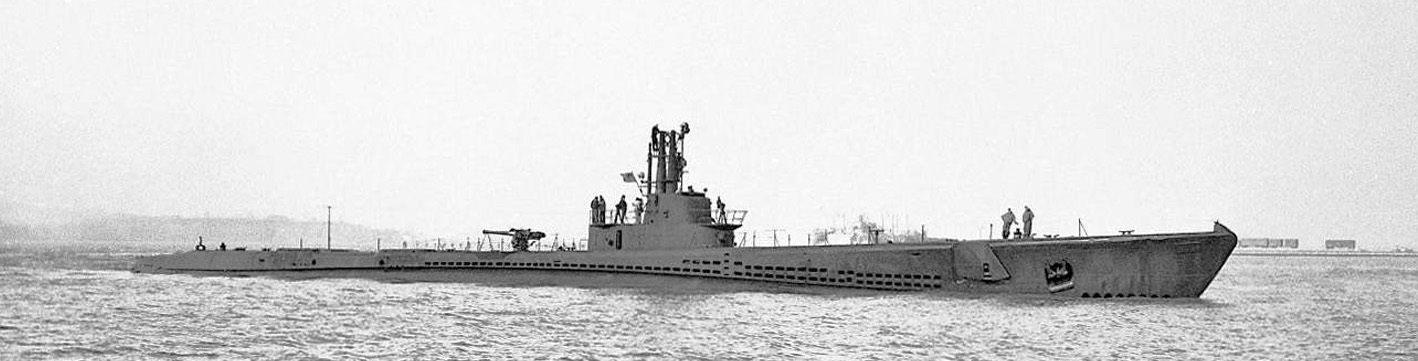
During the second world war, submarines came into their own as instruments of war. In the Pacific theater, US submarines disrupted Japanese shipping of supplies, material and personnel. Unlike the German wolf pack strategy, US submarine captains usually operated independently. As the captain of the USS Lox, a (fictional) Salmon-class boat, you are responsible for 58 officers and enlisted submariners. Your mission is to disrupt Japanese war operations by sinking as much shipping as possible.
Setup
You will need:
- a standard deck of cards and
- a copy of these rules.
Shuffle the cards. Deal 24 cards face down to represent your supply and set aside the rest of the deck. From your supply, deal (face down) a grid of cards to represent the Pacific Ocean. For the your first game, lay out a 3x3 grid. In subsequent patrols captains should decide how many resources to expend searching for targets.
Turn order
Each turn represents an encounter with an enemy convoy. The game ends when the USS Lox runs out of cards in the supply deck, is sunk by enemy forces (4b) or the player decides to return to port (5).
-
Up periscope—Flip any card in the grid. The card represents a ship you may chose to attack.
-
Attack decision—Captain decides whether the situation is favorable.
a. If you decide not to attack, discard the ship and continue the war patrol with another up periscope step.
b. Otherwise, decide how many torpedoes to fire in spread formation. Place up to three cards from your supply face down on the table.
-
Torpedoes away!—Determine if you sank the ship based on whether your cards scored at least one point according to the rules of cribbage.
a. If the revealed ship is a jack, it’s immediately sunk with the USS Lox’s deck gun. No torpedoes are expended. (This is “two for his heals”.)
b. Using the revealed ship card and all torpedo cards, the ship is sunk if there is at least one:
- pair
- set of cards that add up to 15 (Face cards are worth 10.)
- run of three or more cards (Ace is low and the cards need not match suit.)
- four cards are of the same suit
- jack played as a torpedo that matches the suit of the ship card (his nob)
You must use all the torpedoes even if there is a hit before the final torpedo is revealed.
c. If there is no way to score any points with the ship and torpedo cards, the ship escapes without damage and the USS Lox must attempt to evade escorts.
-
Run silent—Attempt to escape the escorts.
a. If the ship was sunk in the attack, the USS Lox slips away automatically in the confusion. Place the ship in your score pile.
b. If the attack failed, discard the ship and draw another ship from the set-aside deck. It is an enemy escort ship barring down on your position. You may either:
- Escape—Discard as many cards from your torpedo deck as shown on the escort card. (Ace is 1 and face cards are 10). Place them face down at the bottom of the deck. If you don’t have enough torpedoes to discard, the USS Lox has been lost at sea with all crew.
- Attack—Attempt an attack on the escort using procedure in (3) Torpedoes away!. If the attack succeeds place the escort in the score pile. If the attack fails, the USS Lox has been destroyed.
-
Debrief—Decide whether to return to port or continue on patrol.
You may decide to end the war patrol and begin scoring or continue another turn starting at Up periscope (1).
War patrol report
The game ends in one of three ways:
- The USS Lox is sunk by an escort (4b),
- You decide to end the patrol (5) or
- There are no more ships to flip in the ocean (1).
If the USS Lox returns to port, that’s a win. If the USS Lox is sunk, it counts as a loss, but you can still score up any tonnage you might have sunk.
Add up the number on all sunk ship cards (aces are 1 and face cards are 10) and multiply by 1,000 tons. (Example: If you sink ace, three, and queen, that ads up to 14,000 tons.)
The average patrol sunk 3298 tons. The USS Tang sank 96,628 tons in 5 patrols (average of 19,326 tons a patrol), but was sunk by her own torpedo on October 24, 1944. USS Flasher sank 100,131 tons in 6 patrols (16,689 per patrol) and was starting her seventh when the war ended.
Advanced rules
Once you’ve played once or twice, add in these to make the game more challenging.
Jokers
During setup, shuffle two jokers into the deck. If you flip a joker in the Up periscope (1) step, immediately draw an escort (4b). If one of your torpedoes in an attack (3b) is a joker, your attack fails and you must face an escort. If the attack is against an escort, the USS Lox is sunk.
Sinking face cards
When you sink a face card ship (jack, queen or king), discard the ship and place a card from the deck (face down) in your sunk ship pile. At the end of the patrol, naval intelligence estimates their tonnage and you can score these cards as normal.
King ships
If you flip a king ship (1), it’s an escort ship. You must either take damage or attack (4b).
Queen ship
If you sink a queen ship (3b), you may decide to flip another ship from the deck as an opportunity target. You can decide whether or not to attack (2) as if it were a normal ship.
Second patrol
After returning to port, deal another 24 cards from the deck, lay out the ocean grid and play out another patrol. If there are fewer than 24 cards, you may chose to leave some in the deck. If you fail an attack (4b) and there are no more cards left in the deck, the USS Lox is sunk.
Alpha Version
This is an alpha version of this game. If you try it out, please send me an email at jon@jlericson.com. It would help if you answered a few questions:
-
Did you play at least once? If not, what blocked you from making progress?
-
Did you win on your first play?
-
Did you try again with any advanced rules? If so, which rules and were they easy to play?
-
Approximately how long did you take reading the rules and playing?
-
What will you take away from the experience?
Acknowledgments
I was inspired by the simplicity of Battle Card: Market Garden, which was designed by Nils Johansson and David Thompson, which I greatly enjoyed.
My interest in the subject matter came from Sid Meier’s Silent Service, which was likely the first computer game I ever bought.
Cribbage scoring
From Wikipedia:
- fifteens
- 2 points for each distinct combination of two or more cards totalling exactly fifteen (counting aces as one, face cards as ten)
- runs
- 3 points for a run of three consecutive cards (regardless of suit)
- 4 points for a run of four
- 5 points for a run of five
- pairs
- 2 points for a pair of cards of the same rank
- 6 points for three cards of the same rank (known as a “pair royal”, comprising three distinct pairs)
- 12 points for four cards of the same rank (a “double pair royal”, comprising six distinct pairs)
- flush
- 4 points for a flush, where all four cards in the hand are of the same suit, with an additional point if the starter card is also of that suit. (Note that four suited cards including the starter, but missing one of the cards in the hand, does not score for flush.)
- his nob
- 1 point for holding the jack of the same suit as the starter card
- his heals
- 2 points to the dealer if the starter card is a jack