Race for the Galaxy's solo robot is sorta magic
Originally published on Board Game Geek.
I should start by saying I’m not really the target audience for this box. My opinion on RftG can be summed up:
It’s an excellent game. But it’s an excellent game that I had to play dozens of times to appreciate. Most of those plays left me slightly annoyed and confused about what made so many people love this game so much.
I play it online from time to time, but my physical copy rarely gets played. Expansion and Brinkmanship includes three expansions that are out of print in an affordable package compatible with the second edition of the base game. The new systems are designed for people who have played the base game so many times they’ve wrung out many of the interesting decisions from the base game and are looking for something more. Since these expansions are no longer available on their own, it’s great that they have been released as a bundle.
My interest is primarily the solo mode that came in the first expansion, The Gathering Storm, and was itself expanded by Rebel vs Imperium and The Brink of War. Instead of being spread across three boxes, you can now get all the official solo content in one place. (Note, however, there are Updated Solo Rules for RFTG: Expansion and Brinkmanship which clarify the robot’s use of the prestige mechanism added in the third expansion.)
The core of the system is the robot’s play mat and custom dice.
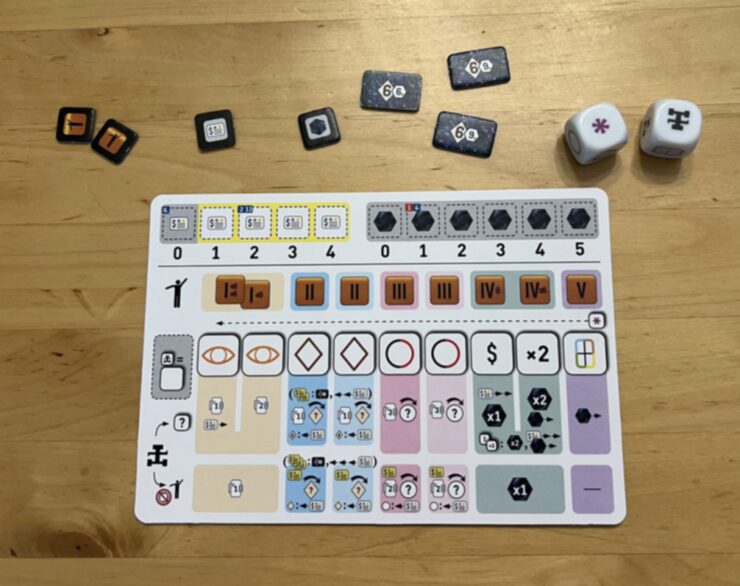
The play mat gives default instructions about how the robot plays each phase. Just like a human opponent, it follows all the selected phases. It also has two dice that have sides that match the symbols on the play mat. When it takes those actions, the robot gets its own version of the bonus for selecting the phase. To be clear, the robot cheats. Just like any cardboard AI, it can’t make decisions that work as well as a human player. Instead it’s designed to simulate the outcome of those decisions. So instead of playing for cards from its hand, you flip through the robot’s deck that represents its hand until you find the right type of card for the action. That can lead to the odd situation where the robot selects develop, but runs out of cards before finding a development card. On the other hand, if the top card is a 5-cost development, it doesn’t expend any cards to build it. (There are special rules for 6-cost developments which do come at a cost.)
There are different versions of the robot determined by the robot’s start world. The back of the play mat and the rulebook show which overlay pieces to take to alter the robot’s behavior.
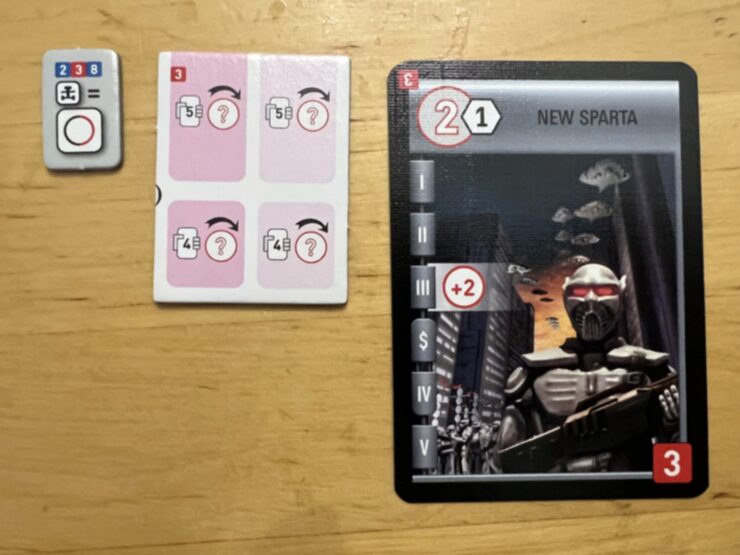
The New Sparta robot uses the military strategy to conquer worlds. Instead of flipping for worlds with back circles, it flips for military worlds with red circles. That’s what the icons mean on the large pink tile. The small grey tile is the robot’s prefered action tile, which is to take a settle action. One of the dice has two faces with the robot icon. If that turns up, it uses the robot’s preferred action, which is to settle for New Sparta.
Note that the pink tile has a mark on the left side that looks out of place. I originally assumed it was a printer mistake until I put the robot tiles on the play mat.
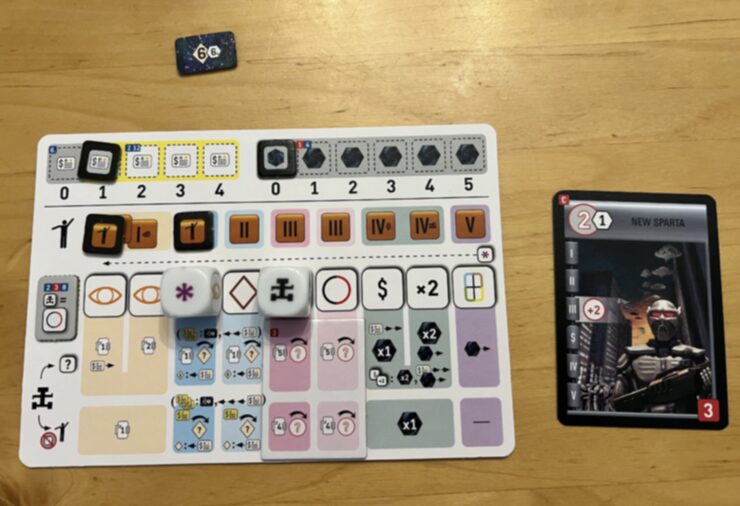
This indicates the level of care given to the details of the solo mode. That mark is actually the close parenthesis of the develop action that would be covered by this robot’s settle overlay. Completely unnecessary, but appreciated nonetheless. I also appreciate the numbers on the tiles that match the number on the start world.
In the above image, you can see one of the dice has the star (*) icon. This indicates the robot will match the human selection. It’s a way for the human to influence the bot. Since you know what the robot will try to do, you can sometimes select phases it doesn’t get much benefit from and when it randomly matches your selection, it will be stuck doing something suboptimal. Again, the robot cheats, so you shouldn’t feel bad about exploiting it sometimes.
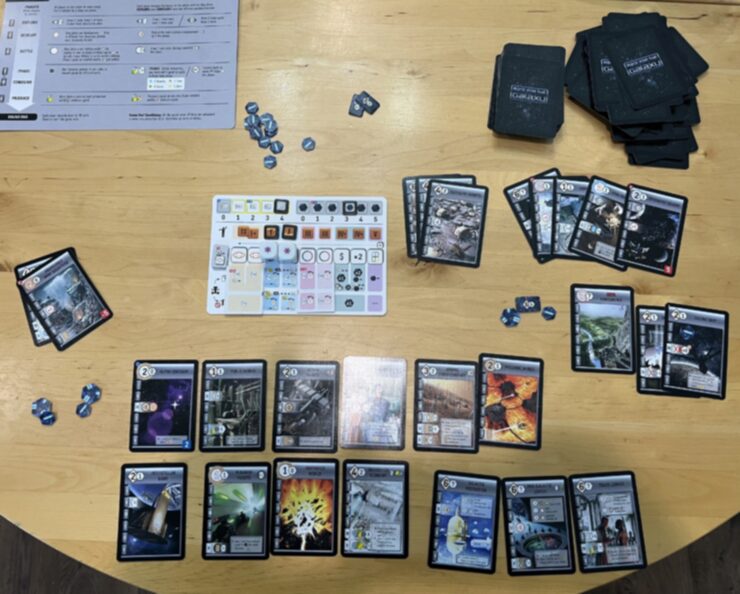
Playing the bot is fairly simple once you internalize the symbols. (This is Race for the Galaxy, afterall.) Taking the robot’s actions doesn’t take much effort either. Games go fairly quick and the robot scoring is simpler than the regular scoring rules. Instead of calculating the score of 6-cost developments, they simply provide 6 points (9 points for the hard difficulty). Again, the robot cheats because it doesn’t know how to set up synergetic strategies. Games are close for me even on the easy difficulty.
There are plenty of robots to play against and you can slowly add in the new cards from each expansion too. The robots use the optional modules (goals and takeovers), but they do work with the other cards in the expansions and the prestige rules. It’s a well-implemented solo system and worth getting even if you don’t plan to play with other people.
So that’s the traditional ending of the review. I’m not quite done yet, but I’m going to put the rest of my thoughts in a spoiler tag because . . . I’m about to do the equivalent of revealing a magic trick.
Spoilers!
Theme in games is always an illusion. Take Lost Cities, which is essentially an abstract card game, but has a theme that’s effective for me. After I worked out how to run the robot, I felt like Race for the Galaxy’s solo system really did put me in a competition between galactic civilizations. I looked forward to turning a random start card to see what sort of civilization I would face. And the robot actions do feel very thematic to the chosen start world.
As I played more games, however, I noticed I wasn’t paying much attention to the robot tableau. I started overlapping cards to save a bit of space on the table, Then I got into a habit of shoving the tableau into a stack after the first 6 cards were played so that I could see the robot’s progress at a glance. My goal began to be building my tableau to twelve before the robot finished the game. While the timing does vary and I haven’t recorded game length, it feels like robots that focus on building get out a card a turn or so. When the robot beats me, I notice how lucky it got with 6-cost developments (or the 7-point Rebel Homeworld). And that’s when I realized that while I appreciate the clever design of the robots, I’d probably be just as happy playing against a fixed number of turns and a score threshold. Maybe something like the Ares Expedition solo mode.
Perhaps what I’m really looking for is something along the lines of the Race for the Galaxy Solo Campaigns which explore different RftG strategies. The robots were carefully designed to push back against experienced players by using experienced play as a model input. This gets at my fundamental tension with the RftG design. I’m looking to explore a vast universe and the game system rewards deep knowledge of the cards that might come into play.
That said, I’ve only opened The Gathering Storm set and I should probably finish the rest of the robots to see what tricks they are hiding. And maybe up my winning percentage against the easy difficulty too. 😜